Corridor read
Ancient Pyramids Around the World
Egypt is home to more than 100 pyramids, but the Pyramid of Djoser was the earliest of them. It was constructed during the reign of Pharaoh Djoser, from 2630 B.C. to 2611 B.C., as an imposing burial monument for the ruler. Before this period, royal tombs were generally flat-topped mounds constructed primarily from mud. Djoser’s chief architect, Imhotep, introduced a more lasting and visually striking approach with the creation of the step pyramid. The structure consists of six limestone levels, each smaller than the one beneath it, reaching approximately 200 feet into the air. Imhotep was also regarded as a healer and was eventually worshipped in Greco-Roman times as a deity associated with medicine.
Selah Monroe
Temple note
Layer tip
The full corridor digest continues below along soft meter ticks.
Path
Temple Corridor
Saqqara, Egypt: Pyramid of Djoser
Egypt is home to more than 100 pyramids, but the Pyramid of Djoser was the earliest of them. It was constructed during the reign of Pharaoh Djoser, from 2630 B.C. to 2611 B.C., as an imposing burial monument for the ruler. Before this period, royal tombs were generally flat-topped mounds constructed primarily from mud. Djoser’s chief architect, Imhotep, introduced a more lasting and visually striking approach with the creation of the step pyramid. The structure consists of six limestone levels, each smaller than the one beneath it, reaching approximately 200 feet into the air. Imhotep was also regarded as a healer and was eventually worshipped in Greco-Roman times as a deity associated with medicine.
Giza, Egypt: Great Pyramid of Khufu
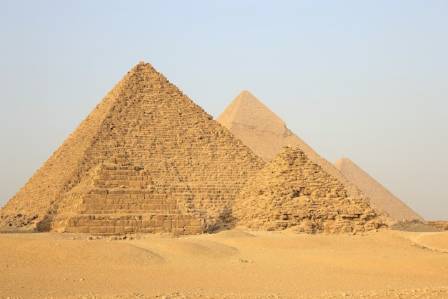
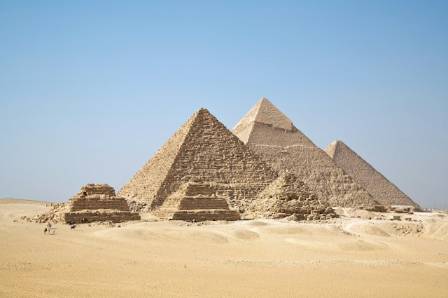
When people hear the phrase “the pyramids,” many immediately imagine the celebrated group rising above the desert outside present-day Cairo. The northernmost and largest of the three, constructed around 2551 B.C. for Pharaoh Khufu, is commonly known as the Great Pyramid. More than 2 million stone blocks make up the enormous geometric structure, which stands about 450 feet high today and originally reached 481 feet.
For more than 3,000 years, the Great Pyramid held the distinction of being the tallest human-made structure in the world. Although it no longer holds that record, it remains the largest of the ancient pyramids. The ancient Greeks included it among the Seven Wonders of the World, and it is the only monument from that original list that still survives today.
Giza, Egypt: Pyramid of Khafre
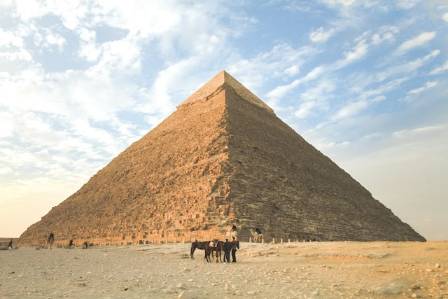
The central pyramid at Giza was constructed around 2520 B.C. as the tomb of Pharaoh Khafre. Its height of 471 feet makes it slightly shorter than the Great Pyramid built for his father, Pharaoh Khufu. However, Khafre selected a location at a higher elevation, creating the visual impression that his pyramid was taller.
To the east of the pyramid lies an extensive temple complex featuring a huge limestone monument with the body of a seated lion, a human face with its nose missing, and the traditional headdress of a pharaoh. This enigmatic monument is known as the Sphinx.
Chavin de Huantar, Peru: Chavin Temple Complex
The enormous Chavin temple complex was developed over several centuries by the pre-Columbian Chavin people, who inhabited the highlands of present-day Peru from approximately 900 to 200 B.C. Its monuments include an “old temple” and a “new temple,” both constructed from rectangular stone blocks and designed in the form of flat-topped pyramids.
The complex contains intricate carvings, narrow passageways and channels designed to carry water, features that may have played roles in religious ceremonies. Although much of the site now lies in ruins, its impressive scale astonished a Spanish explorer in the 16th century. He was so amazed by what he saw that he believed the structures must have been created by an ancient race of giants.
Teotihuacan, Mexico: The Pyramid of the Sun
Little is known about the people who built and occupied the central Mexican city of Teotihuacan during the first centuries A.D., but the remains demonstrate a remarkable level of architectural ability. The carefully planned city extended across more than seven square miles and contained several large pyramids, with the Pyramid of the Sun being the most imposing.
The square foundation measures roughly 730 feet along each side, while its five stepped levels originally reached more than 200 feet in height. The pyramid stands beside the city’s principal avenue, known as the Avenue of the Dead. This major roadway extends southward from the Pyramid of the Moon toward a large temple complex.
Meroe, Sudan: The Nubian Pyramids
Hundreds of pyramid-shaped burial monuments can be found across the region of central Sudan that was historically known as Nubia. Most were constructed from distinctive reddish sandstone. Around 40 of these pyramids stand at Meroe, which served as an important center of the Kushite kingdom from approximately 300 B.C. to 300 A.D.
Compared with the monumental pyramids of Egypt, the Nubian examples are considerably smaller and have much narrower profiles. Over the centuries, many were damaged by looting and natural deterioration. During the 19th century, an Italian explorer even destroyed the tops of numerous pyramids while apparently searching for buried treasure. Despite this damage, the remaining structures continue to form a remarkable archaeological landscape.
Puebla, Mexico: Great Pyramid of Cholula
At first glance, the monument in the Mexican state of Puebla may appear to be nothing more than a grassy hill. In reality, it conceals one of the largest ancient monuments in the world. The pyramidal complex covers nearly 45 acres and rises about 177 feet above the surrounding landscape.
Its formal name is Tlachihualtepetl, although it is more commonly known as the Great Pyramid of Cholula. Pre-Columbian peoples constructed the monument in a series of stages, and the Aztecs later used it as a temple dedicated to the god Quetzalcoatl. Following the Spanish conquest of the city during the 16th century, colonizers built a Catholic church directly on top of the grass-covered pyramid.
Ur, Iraq: Ziggurat of Ur
The term ziggurat comes from a Babylonian word meaning “tall” or “lofty” and refers to the stepped temple structures characteristic of ancient Mesopotamia. Because they consist of progressively smaller levels stacked above one another, their form can also be compared with that of a step pyramid.
The Ziggurat of Ur was commissioned by the Sumerian king Ur-Nammu during the middle of the 21st century B.C. Originally, it consisted of three terraced brick levels linked by stairways and crowned with a shrine dedicated to a moon god. Over the centuries, the monument deteriorated, but Babylonian king Nebuchadnezzar II restored it during the 6th century B.C. Archaeologists carried out additional restoration work in the 20th century. Tallil Airbase is now situated in the surrounding area.
Peten, Guatemala: Mayan Pyramids of Tikal
From approximately 300 to 900 A.D., Tikal served as a major urban and ceremonial center of the Maya civilization. The Maya constructed numerous monuments throughout the site, including five large pyramid temples. The tallest of them, Pyramid IV, rises 213 feet and is crowned by the Temple of the Two-Headed Serpent.
After the Maya eventually abandoned Tikal, the pyramids and other structures became largely hidden and forgotten beneath the rainforest for nearly eight centuries. European explorers rediscovered the ruins with great enthusiasm during the 1850s, prompting several significant archaeological expeditions and excavation projects. Today, the site is recognized as a UNESCO World Heritage Site.
Rome, Italy: Pyramid of Cestius
The sharply pointed Pyramid of Cestius was constructed around 12 B.C. as the burial monument of the Roman magistrate Gaius Cestius Epulo. An inscription carved into the exterior identifies Cestius and his heirs and records that the pyramid was completed in only 330 days.
The monument was built from concrete and faced with white marble, while its interior walls were decorated with paintings. In 1887, English poet Thomas Hardy wrote several lines after seeing the pyramid. He regarded the nearby graves of poets John Keats and Percy Bysshe Shelley as more meaningful than Cestius’ monument. Hardy expressed his reaction by writing: “Who, then, was Cestius, and what is he to me?... I can recall no word, Of anything he did; For me he is a man who died and was interred, To Leave a pyramid.”
More along this corridor
MID · en

Which chair is good for your back?
A comfortable and supportive chair plays an important role in maintaining your overall comfort and health. Whether you are working in an office, studying at home, or simply relaxing, having the right seating can make a major difference.
MID · en

Cute Rabbits to Draw
There’s nothing quite as heartwarming as watching your pet rabbit—the twitching little nose, ears perked up with curiosity, and that adorable way they curl into a tiny loaf of fluff. Capturing that personality on paper is a wonderful way to celebrate your furry companion, and the great news is, you don’t need professional skills to start.
MID · en

The Most Variable and Historic Deer
Among the diverse family of cervids, the fallow deer stands out for its remarkable color variations, unique physical characteristics, and ancient relationship with humans. This elegant species has traveled far beyond its native eastern Mediterranean habitats to establish itself across all inhabited continents, creating a living legacy that spans millennia. From its distinctive appearance to its fascinating behaviors, the fallow deer represents one of nature's most adaptable and historically significant ungulates.
MID · en

Escape the Urban Hustle: Reconnect with Nature
In the midst of the urban frenzy, there exists an age-old remedy to alleviate stress and anxiety, and rekindle your inner strength: the art of travel. The urban jungle, with its concrete canyons and ceaseless commotion, is a far cry from the serene wonders of the natural world. To immerse yourself in the embrace of tranquility, all you need is a journey that transports you back to the essence of your being.
MID · en

Top 10 Most Beautiful Women in the World, Ranked by Science
Naming the most beautiful woman on Earth might sound subjective — after all, beauty lies in the eye of the beholder. Still, modern science has developed ways to analyze physical attractiveness using mathematical principles that offer some objective perspective. Dr. Meegan Gruber, a Florida-based board-certified plastic surgeon, explains that while beauty standards shift with culture and time, certain universal traits consistently appeal to human perception. “The way we define beauty is influenced by both societal norms and individual preferences,” she says. “But mathematics, like the Golden Ratio, has long been used to assess symmetry and proportion — key aspects of perceived beauty.”
MID · en

How To Make Macarons
Enjoying dessert is one of life’s sweetest moments. Whether you reach for a cookie, a slice of cake, or a piece of pie, every bite can feel like a small escape. The next time you want something special, try making macarons. These elegant sandwich cookies bring a touch of sophistication to any celebration with their beautiful colors, smooth tops, crisp shells, and soft, chewy centers.